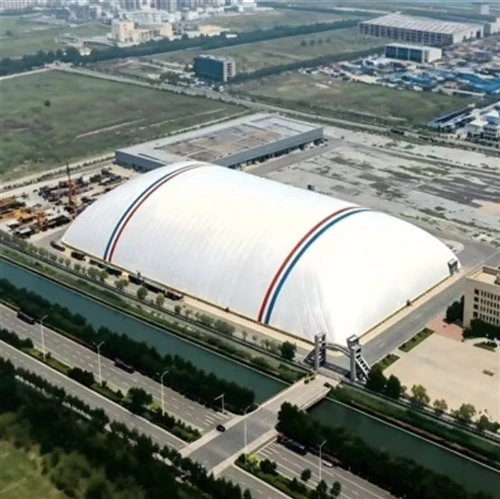
TL;DRAn air supported structure spans up to 200 m with no interior columns. It is rated for 67 m/s wind and 250 kg/m² snow, and fan electricity is its only running cost. A steel warehouse needs no power but needs columns as spans grow. For open bulk-material yards where loaders and trucks need free floor, the air supported structure is usually the better fit. All specs below come from CWTC's air dome system.
By CWTC Technical Team | 5 min read
If you run a port yard, an ore or coal stockpile, a fertilizer plant or a logistics hub, you face two pressures. Material has to stay dry and dust has to stay inside. Loaders, conveyors and trucks also need to move without columns in the way. A steel warehouse is the default answer. The air supported membrane structure is the challenger, and it raises fair questions: what holds it up, what happens in a storm, and what does it cost to run?
How Does an Air Supported Structure Work?
|
|
A building held up by airAn air supported structure is a large enclosed space formed by a flexible membrane that internal air pressure holds up. Fans keep the pressure slightly above the outside air, and that small difference is enough to keep the membrane inflated and the shape stable. The edge is anchored to a foundation, and steel cables restrain the membrane against wind and snow. Nothing inside has to carry the roof, so the interior is free of beams and columns. That gives loaders and trucks open floor, and lets the layout follow the work instead of a column grid. Five advantages named on CWTC's product page:
|
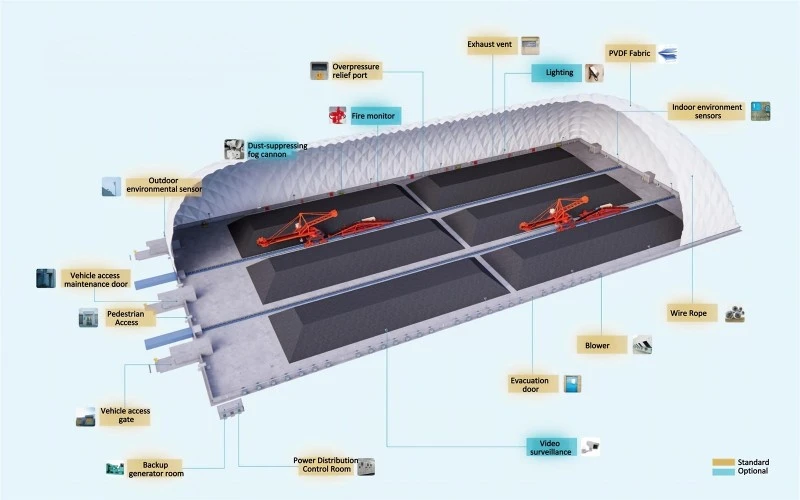
Click a numbered dot to see each part and its key figures.

1. Membrane
Coated fabric held up by air, not by beams.
| Weight | 0.75 to 1.2 kg/m² |
| Tensile strength | 500 to 1,000 kg per 5 cm |
| Service life | 25 years |
| Fire, temperature | Class B1 fire-retardant, -40°C to 70°C |

2. Steel cable net
Cables restrain the membrane against wind and snow. A PE coating protects the fabric.
| Cable diameter | 12, 16, 18 or 22 mm, by span |
| Wind capability | 67 m/s |
| Snow load | 250 kg/m² |

3. Foundation
A strip footing below the frost line resists uplift.
| Type | Spread-footing strip foundation |
| Depth | Below the frost line |
| Ground | Fill, permafrost, soft soil, loess |

4. Fans and control
Fans hold the pressure. The PLC adjusts it to wind and snow.
| Fans | One active, one standby |
| Control | Variable frequency, preset pressure |
| Backup | Diesel generator, automatic |
| Energy | 25,000 to 40,000 kWh a year per 10,000 m² |

5. Access doors
Interlocking doors keep the structure pressurized.
| Vehicle door | Interlocking high-speed roll-up |
| Cycle time | 10 seconds |
| Throughput | At least 80 vehicles an hour |
| Personnel door | Interlocking hydraulic |

Air Supported Structure vs Steel Warehouse: Side by Side
Pick a tab to compare one decision area at a time. CWTC figures come from its product page. Steel entries describe typical practice, not a specific supplier.
When steel still wins: choose it if the site has no stable power and no budget for a standby generator, if the roof must carry overhead cranes or heavy equipment, or if local permitting favors a conventional building.
How Strong Is 67 m/s?
CWTC states that the cable system withstands wind of 67 m/s and a snow load of 250 kg/m². Drag the slider to see what that wind means. 67 m/s sits above Level 17, the top step of China's 0 to 17 typhoon scale.
DRAG TO CHANGE THE WIND SPEED
Red mark: 67 m/s
67 m/s = 241 km/h
Above Level 17 | Super typhoon
Within the 67 m/s the cable system is stated to withstand.
Scale: China typhoon levels, an extension of the Beaufort scale.
What Happens in a Power Cut or an Air Leak?
This is the first worry most buyers raise. Here is how the design answers it, using only features listed on CWTC's product page.
- Backup power: a standard diesel generator switches on automatically when mains power fails.
- Fan redundancy: fans run on a one-active, one-standby basis, so a single fan fault does not stop the air supply.
- Pressure control: variable-frequency fans start and stop at preset pressure, and the PLC adjusts pressure to wind speed and snow load.
- Pressure kept at the doors: interlocking vehicle and personnel doors limit air loss while people and trucks pass.
As a general principle, an air supported structure does not need to be airtight. The fans replace small leaks and the working pressure is low. For emergency supports or deflation behavior on your project, ask CWTC to confirm the design in the proposal.
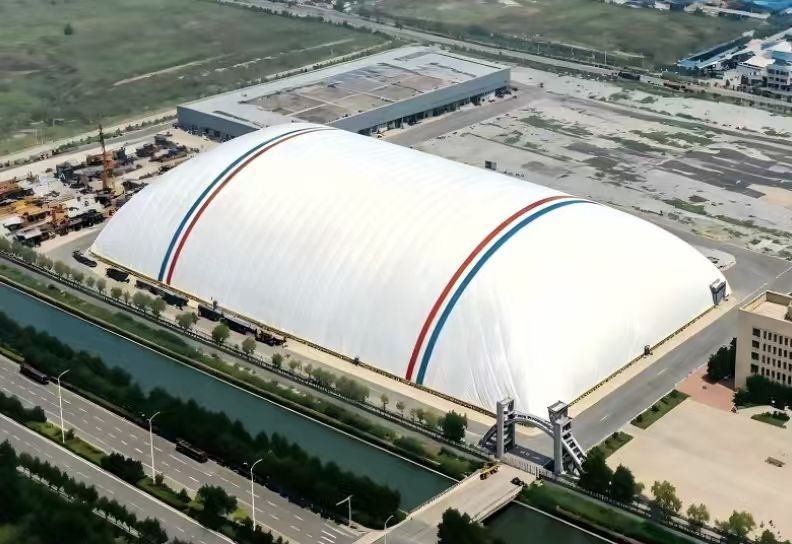
Where It Is Used: Pick Your Material
Choose a material to see the typical problem and how listed CWTC projects handled it.


Why Buyers Choose CWTC
|
01 One source, whole systemCWTC integrates structures, power, climate control and furnishings into compatible systems, so one team is accountable. |
02 20+ years, global deliveryCWTC has deployed shelter and infrastructure solutions in Poland, the UK, Egypt, Kenya, Uganda, Rwanda, the Philippines, Malaysia, Costa Rica and Ecuador. |
03 OEM and ODM, from MOQ 1 setSize, door count, insulation and HVAC can be tailored. Training and remote monitoring support operation after handover. |
CWTC also lists ISO 9001:2015, ISO 14001:2015 and ISO 45001:2018 on its product page. For the full air supported structure range or a wider one-stop solution, see the pages linked here, or read more about CWTC.
What CWTC Needs to Quote Your Project
Send these six items and CWTC can review them and prepare a technical and commercial proposal.
Size and location
Application and material
Wind and snow load
Doors and vehicle size
Insulation or HVAC
Delivery date
Air Supported Structure FAQ
Move your mouse over a question to open its answer. The previous answer closes by itself.
The membrane has a service life of 25 years. It is acid and corrosion resistant and self-cleaning, and the Class B1 fire-retardant membrane works from -40°C to 70°C.
CWTC can currently build up to a 200 m span, and the length is not limited. Steel cables of 12, 16, 18 or 22 mm are chosen according to the span.
Yes. Fans keep the internal pressure steady, and fan electricity is the only running cost. A 10,000 m² facility uses about 25,000 to 40,000 kWh a year, depending on vehicle traffic. A standard diesel generator starts automatically during a power cut.
Installation usually takes 5 to 7 days, depending on size and complexity. The structure needs an anchoring and foundation system, and the exact design depends on the structure size and site conditions.
The cable system is stated to withstand wind of 67 m/s, which is above Level 17 on China's typhoon scale, and a snow load of 250 kg/m². The PLC also adjusts internal pressure to local wind speed and snow load.
The MOQ is 1 set and the warranty is 12 months. Spare parts can be supplied during the service life of the project, and service after the warranty period is charged.
An air supported structure is not right for every site. It is a strong match for large, open bulk-material yards that need weather protection, dust control and free floor. Check your span, power supply and wind and snow loads first, then compare. Send those details and CWTC will review them and prepare a technical and commercial proposal.
Planning an enclosed storage yard?
Send your size, site loads and delivery date. We reply with a proposal for your yard.
Request a QuoteTalk to an Engineer